| At a glance |
What to do |
| Prepare deliberately |
Use the guidance below during practice. |
| Skill |
Why it matters |
Practice focus |
| Observation |
Supports safer decisions |
Look ahead and reassess |
Under NYC driving laws, a right turn on red NYC drivers might expect is actually prohibited by default. Make one only where a posted sign specifically permits it, and only after the required stop and a careful check that the turn is legal and safe. For Manhattan learners, that rule is a useful way to practice the observation, patience, and decision-making that dense city intersections demand.
Key Takeaways
-
NYC's default rule prohibits a right turn on red unless a sign at that specific intersection permits it (34 RCNY §4-03(b)).
-
A complete stop never creates permission to turn; where a sign allows it, stopping is only one required step among several.
-
A permitted turn still requires yielding to pedestrians, cyclists, and other traffic, and proceeding only when the path is clearly safe.
-
A full scan means checking the crosswalk, the turn path, the space beside the vehicle, and oncoming traffic, not just a glance left.
-
When the sign, signal, sightline, or traffic situation is unclear, waiting is the sound choice.
-
Manhattan has no DMV road test sites, so effective lessons build transferable skills like scanning and decision-making rather than route memorization.
Right Turn on Red in Manhattan: The Rule, the Exception, and the Safer Decision
Do not assume a right turn on red is available in Manhattan just because it may be common elsewhere. The default in New York City is no right turn on red unless a sign at that intersection allows it. A full stop does not create permission by itself, and a driver behind you who is waiting or honking does not create it either.
That distinction matters because a right turn requires several separate judgments: reading the signal and posted signs, stopping correctly, protecting people in the crosswalk, accounting for cyclists or other traffic alongside the car, and avoiding a space that is not clearly available. Manhattan has no DMV road test sites, which is a good reason not to organize lessons around route memorization. The more useful goal is transferable skill: recognizing a controlling sign, stopping without blocking a crosswalk, scanning deliberately, and waiting when the view or the legal situation is uncertain.
Law, Signs, and Driving Advice Are Not the Same Thing
New drivers often hear one compressed instruction: "Stop, then you can turn right." That phrase blends together rules that are different. The law sets the default in New York City and the effect of a specific posted permission, while the signs and signals at the actual intersection control the movement in front of you. Safe-driving instruction then helps you carry out a legal movement without creating risk for others.
A sign that permits a right turn on red does not mean "turn whenever the car has stopped"; you still need to obey any other applicable sign or signal, yield as required, and turn only when the path is clear. A gap in traffic is not permission to turn where the NYC default remains in force. Build the habit of looking for the controlling information at the corner rather than relying on a remembered generalization from another town or state.
Prohibited vs. Permitted Right Turn on Red: What Changes
The table below summarizes how the legal picture shifts across common Manhattan intersection scenarios, and what stays constant regardless of the signal or signage.
|
Situation
|
What Changes
|
What Stays the Same
|
|
No sign permits the turn (NYC default)
|
Right turn on red is prohibited; the driver must wait for a green signal or arrow
|
A full stop is still required, and observation of the crosswalk and traffic still applies
|
|
A posted sign specifically permits the turn
|
The turn becomes legally available after a complete stop
|
The driver must still yield to pedestrians, cyclists, and other traffic, and confirm the path is clearly safe
|
|
The signal turns green
|
The controlling signal now allows forward or turning movement
|
The driver must still scan for pedestrians, cyclists, and conflicting traffic before proceeding
|
|
A driver behind honks or waits impatiently
|
Nothing changes legally
|
Signs and signals remain the only source of permission
|
A Repeatable Approach to Any Manhattan Right Turn
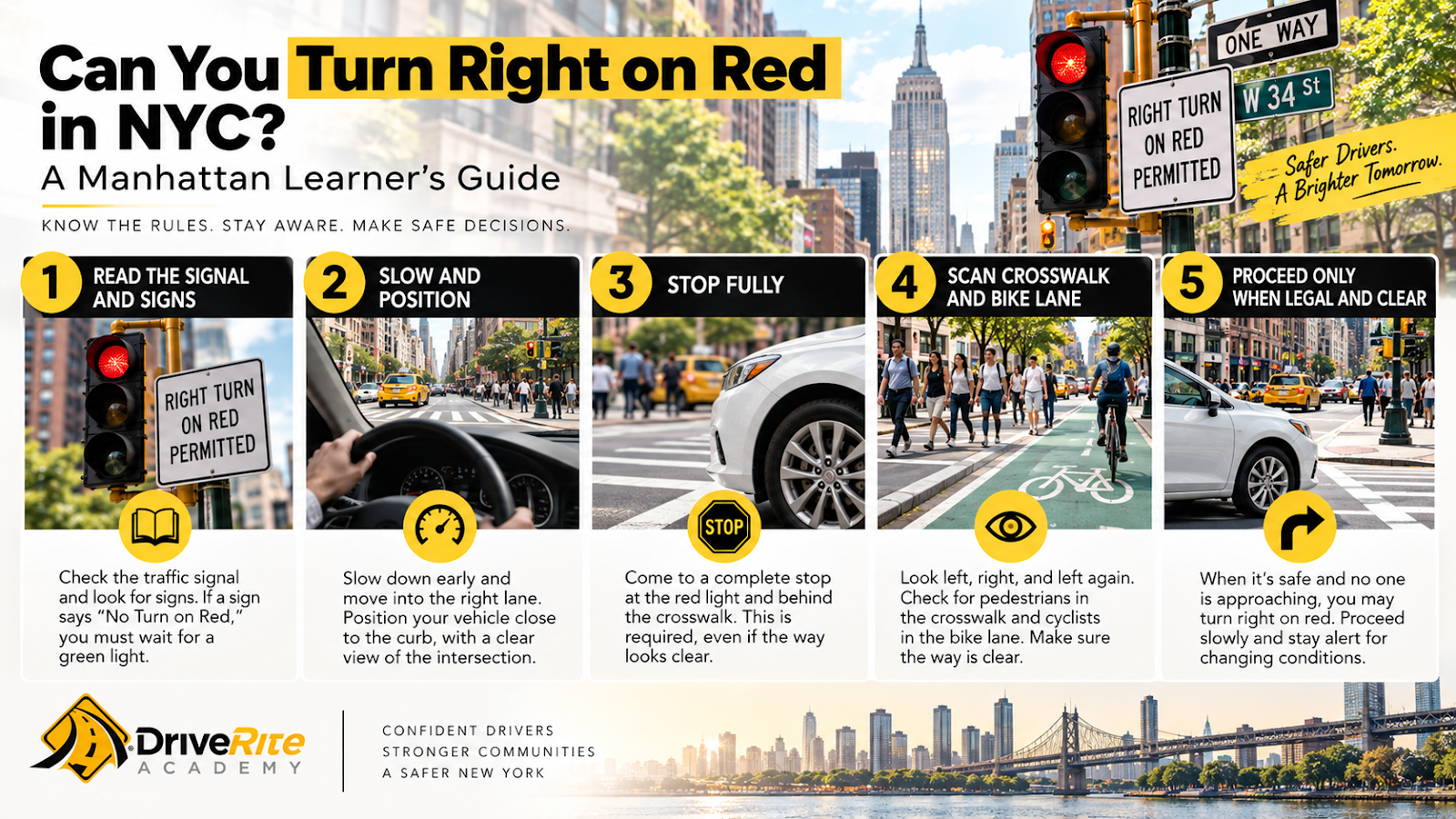
Start the decision before the corner. Easing off early gives you time to read signs, notice a bike lane, and brake smoothly, rather than reacting at the crosswalk.
-
Identify what controls the intersection. Look for the traffic signal, a right-turn-on-red permission sign, restrictions, lane markings, and crosswalks.
-
Set up the vehicle. Signal when appropriate, reduce speed smoothly, and take the lane position the road markings and traffic call for.
-
Stop properly when required. Make a complete stop at the proper point; do not creep into the crosswalk to improve a blocked view.
-
Scan the whole conflict area. Check the near crosswalk, the turn path, the street you will enter, and the space beside the vehicle, using mirrors and a shoulder check where needed.
-
Decide only after the scan. If the turn is prohibited, or people or traffic have the right of way, or the sightline is blocked, wait. If the movement is permitted and the path is clearly safe, complete the turn at a controlled speed.
-
Finish the turn with attention still on. Enter the correct part of the street, avoid swinging wide, and keep watching for pedestrians, bicycles, and changing traffic.
Why Manhattan Corners Require a Full Scan
The risk at a city corner is not limited to cars coming from the left. A crosswalk may be active even when the roadway looks open, a delivery vehicle or bus can block a sightline, and a cyclist can come alongside while you are focused on the signal.
That is why "look, then go" is too vague to be useful. Check the crosswalk because a person there conflicts with your turn, check beside the car because another road user may be crossing that space, and check the path ahead because a stopped vehicle, bus, or pedestrian may make the turn unavailable. A slower, planned approach gives a learner time to process the corner. Good judgment looks like this: a controlled vehicle, a complete stop, a deliberate scan, and a turn made only when the decision is supported by what the driver can actually see.
Common Mistakes and the Better Replacement Habit
Treating every red light as a possible right turn is a common mistake. Start with the NYC default instead: look for a sign that specifically permits the turn, and without one, wait for the signal.
Another mistake is stopping and looking only left. Scan the crosswalk and the full turn path as well as approaching traffic, since the relevant conflict may be in front of or beside the car. Do not creep forward when the view is blocked, and do not let another driver set the pace: a horn communicates impatience, not a legal instruction. A green light changes the signal condition, but the driver must still make the turn safely and yield where required.
Practice That Produces Useful Feedback
Ask for feedback on observable actions: Did I identify the sign early? Did I slow down soon enough to avoid abrupt braking? Where was my car at the stop? Did I check the crosswalk and the area beside the car? Did I move because the path was clear, or because I felt pressure to?
After practice, write one sentence about an actual decision. "I waited because the truck blocked my view" is more useful than "I was nervous," and it identifies a specific scan to improve next time. A DMV-licensed instructor can separate observation, vehicle control, and legal understanding, so specific feedback replaces a general reminder to be more confident.
Drive Rite Academy has trained New York City drivers since 2014, working with more than 5,000 students across Brooklyn, Queens, Manhattan, and Staten Island. Its certified instructors build lessons around New York State DMV standards for defensive driving and traffic law, reinforced through the academy's state-approved 6-Hour Defensive Driving Course and taught in vehicles with dual safety controls. That structured approach, rather than a memorized route, is what carries over to unfamiliar intersections on test day and beyond.
For calm, city-specific Manhattan driving lessons covering turns, observation, and decision-making, explore driving lessons with Drive Rite Academy: https://driveriteny.com/Driving-Lessons-Manhattan
NY State DMV-licensed · Founded 2014 · 6 NYC Locations · 12 Years of Service
Drive Rite Academy has guided New Yorkers to confident, licensed driving since 2014.Explore Driving Packages →
Frequently Asked Questions
Can I turn right on red anywhere in New York City?
No. In New York City, a right turn on red is prohibited unless a sign specifically permits it at that intersection.
If I make a full stop, can I turn right on red?
No. A complete stop does not override the NYC default prohibition. Where a sign permits the turn, stopping is only one part of making a legal and safe decision.
What should I check before a permitted right turn on red?
Read the sign and signal, stop correctly, and check the crosswalk, the turn path, the space beside the vehicle, and approaching traffic. Yield and wait whenever another road user has the right of way or the path is not clearly safe.
What if a driver behind me honks?
Do not let pressure replace judgment. Follow the controlling sign and signal, and proceed only when the movement is legal and safe.
Will Manhattan lessons cover a DMV road-test route?
Manhattan has no DMV road test sites. A useful lesson focuses on transferable skills, including observation, control, signs, turns, and calm decision-making, rather than memorizing a route.
NY State DMV-licensed · Founded 2014 · 6 NYC Locations · 12 Years of Service
See what’s included in Drive Rite’s driving packages — and find the right one for you.View NYC Driving Packages →