How to Change Lanes Safely: 6 Steps from the NY Driver's Manual
Quick answer: Check your mirrors, signal at least 100 feet before you move (New York law), look over your shoulder to clear your blind spot, then ease into the new lane at a steady speed without slowing the traffic behind you. Turn your signal off and settle into the center of the lane.
Fact-checked by our team
Last updated: October 27, 2026
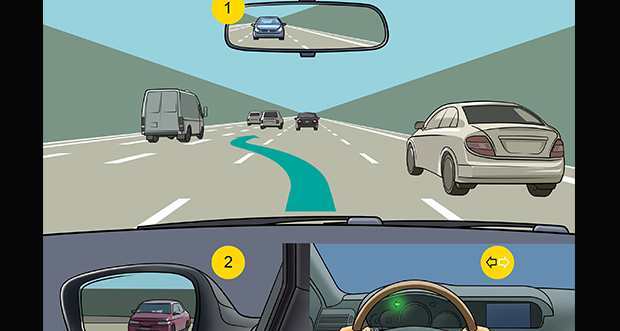
Step-by-step: how to change lanes
- Make sure the move is allowed. A broken white line means you may change lanes when it is safe. A solid white line discourages lane changes, and you must not cross double solid lines (NY Driver's Manual, Chapter 4).
- Check your mirrors. Look in the inside mirror and the side mirror on the side you are moving toward. Note the speed and gap of cars behind you.
- Signal at least 100 feet ahead. New York law requires a turn signal (or hand signal) at least 100 feet before a lane change. Leave it on for the whole move.
- Look over your shoulder. Mirrors leave blind spots on both sides of the car. The Manual says never to depend on mirrors alone: take a quick look over your shoulder through the rear side window.
- Move smoothly at a steady speed. Steer gently into the center of the new lane. Keep pace with traffic, but never speed up past the limit to make a gap. If the gap closes, stay in your lane and try again.
- Cancel the signal and settle in. Turn the signal off, check your mirrors again and leave a safe following distance (at least two seconds) to the car ahead.
Tip: Before you return to a lane after passing, you should see the front bumper of the car you passed in your inside rear-view mirror. That's the Manual's simple check that you've left enough room.
Common lane-change mistakes
- Signalling and moving at the same moment, so other drivers get no warning.
- Skipping the shoulder check and relying only on mirrors.
- Braking while you move over, which can surprise the driver behind you.
- Changing several lanes at once instead of one lane at a time.
- Drifting across the line instead of steering into the center of the new lane.
Lane changes on the road test
Examiners watch for mirror checks, signals and head turns before every lane change. Missing an observation or cutting someone off can cost points. Once you are in the new lane, keep a steady position; our guide on how to stay in your lane while driving explains how.
Frequently Asked Questions
How far ahead do you signal a lane change in New York?
At least 100 feet before you change lanes, as required by New York law and the NY Driver's Manual.
Should I speed up to change lanes?
Keep a steady speed that matches traffic, and never exceed the speed limit. If there isn't a safe gap, wait for the next one.
Can I change lanes in an intersection?
It's best to avoid it. Choose your lane well before the intersection and keep it until you are through.
Is an unsafe lane change a points violation?
Yes. On the NY DMV point system, improper passing or an unsafe lane change is 3 points.
Where is my blind spot?
Behind both sides of your car, just out of view of your mirrors. A quick look over your shoulder is the only way to check it.
Want an instructor to coach your lane changes before the road test? See our driving lesson packages.
For current prices, give us a call at 718-928-7048 or enroll online to see them.
Sources: NY DMV Driver's Manual, Chapter 6: Passing; Chapter 4: Traffic Control; Chapter 8: Defensive Driving; NY DMV, Driver Point System. Checked October 27, 2026. Rules and fees can change, so confirm on the DMV site before you go.